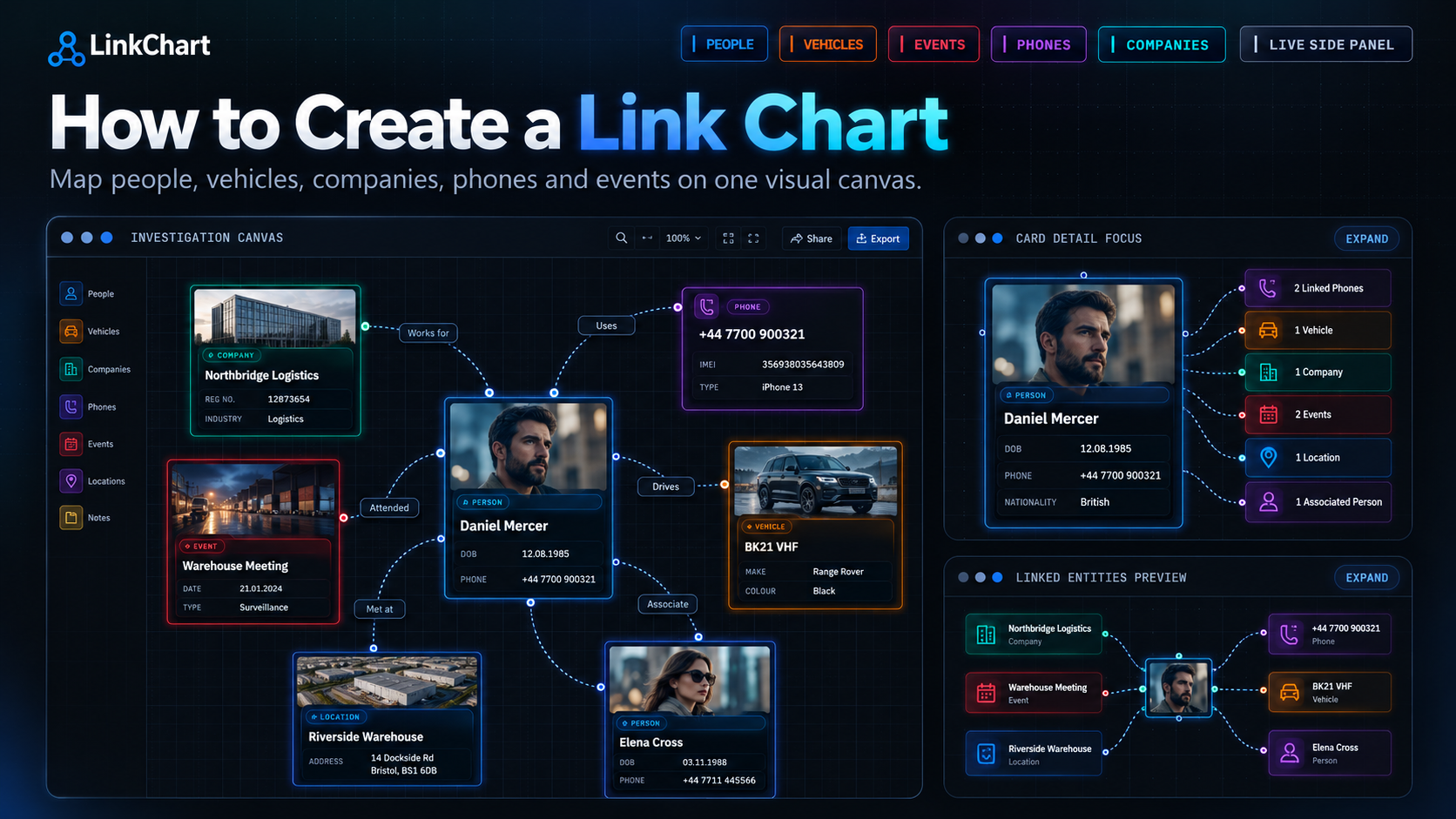
Imagine yourself deep in an investigation, surrounded by a sea of documents, spreadsheets, and notes. The team buzzes with anticipation, yet there's a persistent worry about missing a crucial connection. Those elusive links between entities could make or break the case, but they seem to slip through the cracks. Amidst this chaos, clarity feels like a distant dream. What if there was a way to transform this tangled web into a clear, actionable map? This is where the often-overlooked power of link analysis comes into play, offering a fresh perspective that many overlook. It’s not just about connecting the dots; it’s about understanding the story those connections tell. While many focus on the aesthetics of diagrams, the real magic lies in the details — the labelled edges that reveal the true nature of relationships. This approach doesn't just enhance your investigative prowess; it reshapes the entire process, turning scattered memories into a coherent narrative. In this article, we'll delve into the hidden strengths of link analysis, exploring real-world examples and uncovering insights that could change how you approach your next case.
The Hidden Power of Link Analysis in Investigations
Picture revisiting a cold case that has baffled investigators for years. The evidence exists, but connections between key players are buried in a sea of unlabelled documents and scattered digital notes. The investigation stalls, not for lack of data, but because the relationships are obscured. This is where link analysis can transform the process. By visualizing the connections, investigators can differentiate between hearsay and confirmed links, bringing clarity to the chaos.
For OSINT researchers, the challenge often lies in the sheer volume of data spread across multiple platforms. Each piece of information is a potential clue, but without a coherent map, the significance of these clues can be lost. Link analysis offers a way to consolidate this scattered data into a single, understandable network, allowing researchers to see the bigger picture and identify patterns that might otherwise remain hidden.
Consider a scenario where investigators are dealing with a complex fraud case involving multiple shell companies. Each company has its own set of documents and financial records, making it nearly impossible to see the connections without a structured approach. By employing link analysis, investigators can create a visual representation of the network, revealing how money flows between entities and uncovering potential fraudulent activities. This method not only saves time but also enhances the accuracy of the investigation, providing a robust foundation for legal proceedings.
Why Labelled Edges Matter More Than Pretty Diagrams
In the world of corporate investigations, understanding ownership structures is crucial. Companies evolve, filings change, and without labelled edges, a corporate ownership chart can quickly become an indecipherable mess. Labelled edges provide the necessary clarity, showing not just who is connected, but how they are connected. This is invaluable for compliance teams tracing the flow of money and influence.
Investigative journalists face similar challenges when tracking complex networks of influence. A labelled map allows them to follow the money trail with precision, identifying key players and their roles within the network. This level of detail can turn a nebulous story into a compelling narrative, supported by clear, actionable insights.
Imagine a journalist investigating a political scandal involving several influential figures. Without labelled edges, the relationships between these figures might appear as a confusing web of interactions. However, by using a link chart with clearly defined relationships, the journalist can pinpoint who influenced whom, uncovering the underlying power dynamics. This clarity not only strengthens the story but also provides a visual aid that can be easily communicated to the audience, enhancing the impact of the report.
The Emotional Journey of Mastering Link Analysis
Mastering link analysis is not just a technical skill; it's an emotional journey. Initial challenges can be daunting, but overcoming them leads to a profound sense of confidence. As investigators begin to visualize connections, they experience the satisfaction of eureka moments, where the pieces of the puzzle finally come together.
This journey is marked by a growing sense of control over complexity. As users become adept at creating and interpreting link charts, they find themselves equipped to tackle increasingly complex cases with assurance. The clarity provided by labelled relationships fosters a shared understanding among team members, enhancing collaborative efforts and leading to more effective investigations.
Consider an investigator who has just solved a particularly challenging case using link analysis. The initial frustration of piecing together disparate information transforms into a deep satisfaction as the final link chart reveals the complete picture. This emotional journey not only boosts the investigator's confidence but also reinforces the value of link analysis as a powerful tool in their arsenal.
Common Mistakes in Link Analysis and How to Avoid Them
One of the most common pitfalls in link analysis is relying on unlabelled relationships. Without clear labels, the meaning of connections can be lost, leading to confusion and misinterpretation during briefings. To avoid this, it is crucial to ensure that every edge in a link chart is labelled with its specific relationship type.
Another mistake is mistaking decorative graphs for actionable insights. While visually appealing charts might impress at first glance, they can lack the depth needed for serious investigation work. The focus should always be on the clarity and accuracy of the information presented, rather than on aesthetics alone.
To avoid these pitfalls, investigators should adopt a checklist approach: always verify the source of each connection, ensure labels are consistent and meaningful, and regularly update the chart as new information emerges. By following these steps, teams can maintain the integrity of their link analysis, ensuring that it remains a reliable tool throughout the investigation.
Unconventional Applications of Link Analysis
Link analysis isn't confined to traditional investigative fields. In creative projects, such as literature, it can be used to map character relationships, providing a visual representation of complex narratives. This can offer new insights into character dynamics and plot development.
On a personal level, link analysis can aid in decision-making by visualizing pros and cons as a network. This approach helps individuals see the potential outcomes of their choices more clearly, leading to more informed decisions.
Consider a writer developing a novel with a large cast of characters. By using link analysis to map out character interactions, the writer can ensure consistency in the narrative and explore new plot possibilities. This technique not only enriches the storytelling process but also provides a unique perspective on character development.
Case Study: A Fraud Investigation Unraveled
Consider a fraud investigation where financial transactions are traced through a web of entities. Without a clear map, the connections between these entities remain hidden, making it difficult to present a coherent case in court. By using link analysis, investigators can create a detailed map of transactions, highlighting the flow of money and identifying key players.
Labelled relationship maps play a crucial role in presenting evidence, making it easier for juries to understand the complexities of the case. This clarity not only aids in securing convictions but also enhances the credibility of the investigative team.
In one notable case, investigators used link analysis to uncover a sophisticated money laundering scheme. By mapping out the network of transactions, they were able to identify the central figures orchestrating the scheme and present a compelling case in court. This example highlights the transformative power of link analysis in unraveling complex financial crimes and delivering justice.
The Historical Evolution of Link Analysis Techniques
Link analysis has evolved significantly from its early days. Initially rooted in network theories, it has grown into a sophisticated tool used in various fields. Its development parallels other analytical methodologies, adapting to new challenges and technologies over time.
Today, link analysis is an integral part of investigative processes, offering a level of insight that was previously unattainable. Its ability to transform raw data into meaningful narratives continues to make it an invaluable asset in the pursuit of truth.
Tracing the historical evolution of link analysis reveals its adaptability and resilience. From its origins in social network analysis to its current applications in cybersecurity and digital forensics, link analysis has continually expanded its scope, proving its relevance in an ever-changing world. This journey underscores the importance of innovation and adaptation in maintaining the effectiveness of analytical tools.
How Linkchart Facilitates Clearer Investigations
Some OSINT workflows now keep people, accounts, and organizations on one revisable map instead of scattered tabs. Linkchart's infinite canvas and labelled edges offer clarity under complexity, making it a practical choice for investigators.
By focusing on labelled relationships, linkchart ensures that every connection has a clear meaning, reducing ambiguity and enhancing the overall understanding of a case. This approach not only aids in briefing teams but also in maintaining the integrity of the investigation as new information emerges.
One approach that keeps cases readable is a labelled link chart — linkchart is built around that idea. When relationships stay labelled, briefings get shorter and disagreements get more precise. Clarity is the point: a chart only helps if you can trust what each line means.
Future Trends in Link Analysis
The future of link analysis is poised for exciting developments, particularly with the integration of AI. While AI has the potential to enhance link analysis, it must be implemented carefully to avoid compromising clarity. The goal is to use AI to augment human analysis, not replace it.
Emerging fields, such as cybersecurity and digital forensics, are likely to benefit from advances in link analysis, as they require the ability to quickly identify and understand complex networks. As these fields grow, the demand for sophisticated link analysis tools will continue to rise, driving innovation and expanding the possibilities of what link analysis can achieve.
As AI technology advances, the potential for real-time link analysis becomes increasingly feasible. Imagine a future where investigators can instantly visualize and update complex networks as new data comes in, enhancing their ability to respond to emerging threats and opportunities. This vision underscores the importance of staying ahead of technological trends to maintain a competitive edge in investigative work.
FAQ
What is link analysis used for?
Link analysis is used to identify and understand relationships between entities such as people, organizations, and events. For example, in a fraud investigation, link analysis can help trace financial transactions between multiple parties, revealing hidden connections that might indicate collusion or money laundering.
How does link analysis work?
Link analysis works by visualizing data as a network of nodes (entities) connected by edges (relationships). This method allows investigators to see patterns and connections that are not immediately obvious in raw data. For instance, an OSINT researcher might use link analysis to map out a network of social media accounts to uncover coordinated misinformation campaigns.
What are the benefits of link analysis?
Link analysis provides clarity and insight into complex data sets by visually representing relationships. This can enhance investigative processes by making it easier to spot key connections and trends. In a corporate setting, link analysis might be used to map out ownership structures, helping compliance teams ensure regulatory adherence.
What are common mistakes in link analysis?
Common mistakes in link analysis include failing to label relationships, which can lead to confusion and misinterpretation of the data. Another mistake is using overly complex diagrams that obscure rather than clarify the information. It's crucial to maintain clarity by ensuring that each relationship is clearly defined and relevant to the investigation.
As you delve deeper into the world of link analysis, the satisfaction of connecting the dots in complex investigations becomes palpable. It's not just about mapping entities; it's about the clarity and confidence that come with understanding these intricate networks. Imagine the relief of knowing that every relationship in your chart is clearly defined, eliminating ambiguity and enhancing your investigative rigour.
Some investigative teams are finding that labelled link charts transform their workflows, turning scattered data into cohesive narratives. This approach, exemplified by tools like Disposable Life, empowers users to maintain a shared understanding of cases, ensuring that every line holds significance and every edge tells a story. It's not about the tool itself, but the clarity it brings to your investigative journey.